Category: Uncategorized

  • Custom Coaster Sizes, Shapes, and Thickness: How to Spec the Right Coaster

    Custom Coaster Sizes, Shapes, and Thickness: How to Spec the Right Coaster

    Two bars can order coasters with the same logo and the same budget and end up with completely different results, because the size, shape, and thickness were specced without much thought. A coaster that is too small leaves rings on the bar top, one that is too thin curls into a taco after two pours, and a shape that fights the artwork looks amateur. Speccing a coaster well is not complicated, but it does have an order of operations. Here is how to work through it so the coaster you approve is the coaster your venue actually wants.

    Size the coaster to the glass, not the table

    The job of a coaster is to sit under the widest part of the drink and catch condensation, so the base of your typical glass sets the size. A standard round coaster is 3.5 or 4 inches in diameter, and that range covers most pint glasses, rocks glasses, and pub tumblers with a little margin to spare. Drop to a 3-inch round for stemware and wine service, where the foot of the glass is small and a big coaster just looks clumsy. Go up toward 4.25 inches or more only if you are serving steins, large mason jars, or milkshakes where the base is genuinely wide.

    A useful reality check is that coffee-cup and glass bottoms commonly measure between 60 and 90 millimeters across, so a 3.5-to-4-inch coaster gives you a safe, condensation-catching margin without wasting board. If your venue uses one signature glass, measure its base and add roughly three quarters of an inch on each side; that single number will settle most of the sizing debate.

    Round, square, or a custom shape

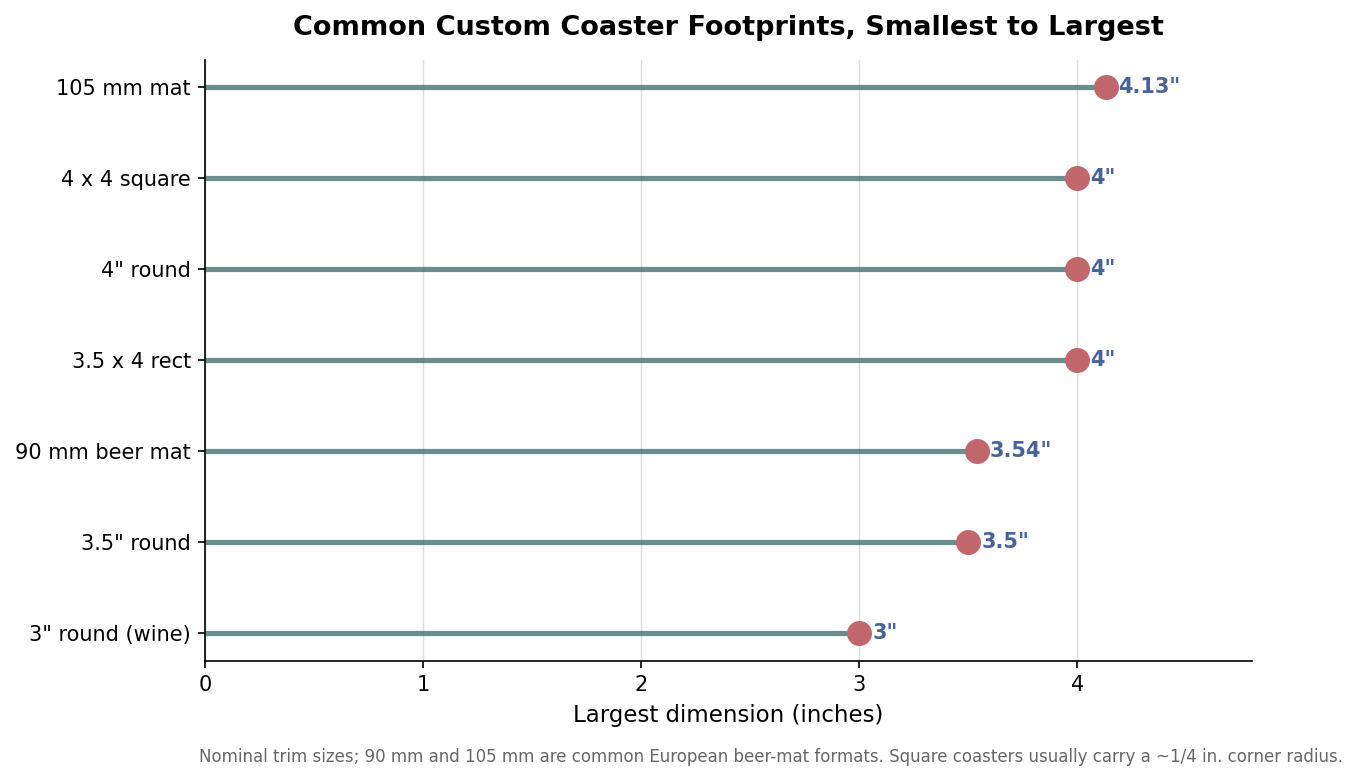
    Round is the default for a reason: it prints cleanly, has no corners to dog-ear, and reads as classic bar-ware. Square coasters, standard at 4 by 4 inches and rarely larger than 6, give you more straight-edge real estate for text and a more modern, design-forward look, and they almost always carry a small corner radius of about a quarter inch so the points do not fray. The North American beer coaster is often a 3.5 by 4-inch rectangle, and European beer mats run in millimeter formats, commonly 90 up to 105 millimeters, which is worth knowing if you are matching an imported brand look.

    Custom die-cut shapes, a bottle silhouette, an arch, a hexagon, are the strongest branding move and the priciest, because they need a cutting die and tighter artwork tolerances. The chart below lays out the common footprints from smallest to largest so you can see where your choice sits.
    Lollipop chart of common custom coaster footprints in inches from 3-inch round to 105mm mat
    Common coaster footprints, smallest to largest; round 3.5-4 inch covers most bar glassware.

    One caution on shape: the more a coaster departs from a circle, the more your bleed and safe margins matter, because a die that lands even a millimeter off will clip a corner of tight artwork. Keep critical text at least an eighth of an inch inside the trim on any non-round shape.

    Thickness: the 40, 60, and 80-point decision

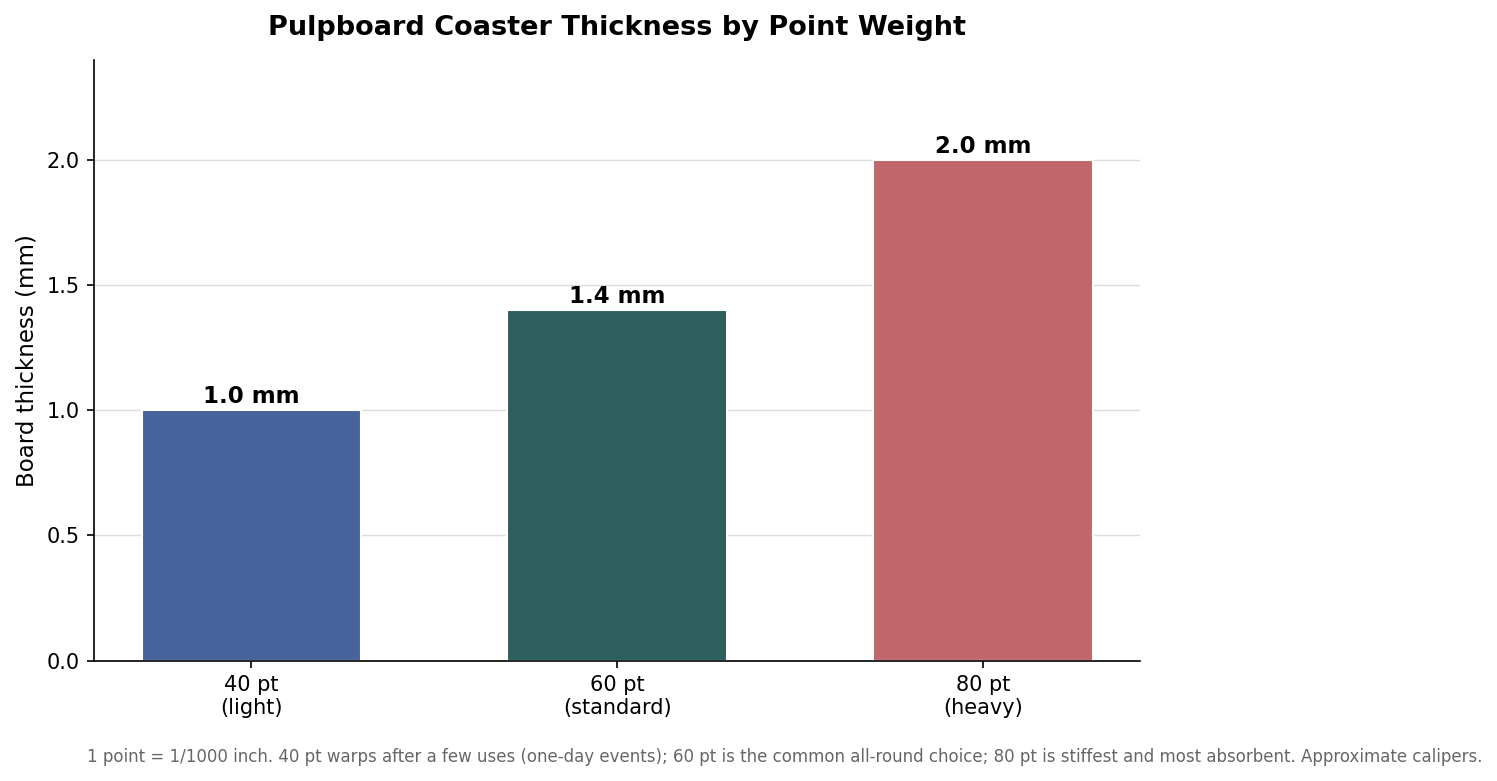
    Coaster board is measured in points, where one point equals one thousandth of an inch, and the three standard pulpboard weights behave very differently in service. Forty-point board is about a millimeter thick, cheap, and light, and it warps after only a few wet uses, which makes it right for one-day work such as festivals, trade shows, and beer tastings where the coaster is nearly disposable. Sixty-point board, roughly 1.4 millimeters, is the standard for a reason: it is the best balance of stiffness, absorbency, and cost, and it holds up to a normal bar shift. Eighty-point board, around 2 millimeters, is the stiffest and most absorbent, the choice when you want a coaster that lasts, feels substantial in the hand, and reads as upscale.
    Bar chart of pulpboard coaster thickness in millimeters for 40, 60, and 80 point board
    The three standard pulpboard weights and their approximate thickness in millimeters.

    The absorbency point is the one buyers underestimate. A thicker, uncoated pulpboard wicks and holds more condensation, which is the whole reason a bar coaster works; a thin board saturates fast and starts to warp. If the coaster is going to see real drinks rather than a single promotional pour, the extra cost of 60 or 80-point board pays for itself in how the coaster looks after an hour on a wet bar.

    Coated or uncoated, and the sharpness trade-off

    Pulpboard can be printed uncoated or given a light top coating, and the two pull in opposite directions. Uncoated board absorbs water beautifully but prints a touch softer, with colors sinking slightly into the fiber. A coating or varnish makes artwork sharper and colors pop, but it also repels water, which undercuts the coaster’s day job. The common compromise is to print on absorbent uncoated stock and accept a slightly matte look, or to coat only for a keepsake or retail coaster where appearance beats function. Decide this based on whether the coaster is primarily a working bar mat or primarily a branded object people take home.

    Putting your spec sheet together

    A clean coaster spec comes together in one line once you have made the decisions above: shape and size driven by the glass, thickness driven by how long the coaster needs to survive, and coating driven by whether looks or absorbency wins. For a working bar, a 3.5 or 4-inch round in 60-point uncoated pulpboard is the safe, sensible default that almost never disappoints. For a wedding or a retail keepsake, an 80-point square or die-cut shape, possibly coated, earns its higher cost. Set those three variables deliberately rather than accepting whatever the order form defaults to, supply artwork with a proper eighth-inch bleed, and the coaster you approve on screen is the one that will actually work under a glass.
  • Custom Wedding Coasters: Sizes, Quantities, and Materials to Order the Right Batch

    Custom Wedding Coasters: Sizes, Quantities, and Materials to Order the Right Batch

    Wedding coasters are one of the few reception details a guest can actually pick up, use all night, and slip into a pocket on the way out. That double life — working drink protector during the party, small keepsake afterward — is exactly what makes them easy to get wrong. Order the size meant for a bar rail and it swims under a water goblet; order a quantity based on guest count when you only need them at the bar and you finish with three unopened boxes. This walkthrough covers the four decisions that actually determine whether your coasters land right: size and shape, how many to order, material, and artwork, plus a realistic ordering timeline.

    Start with size and shape

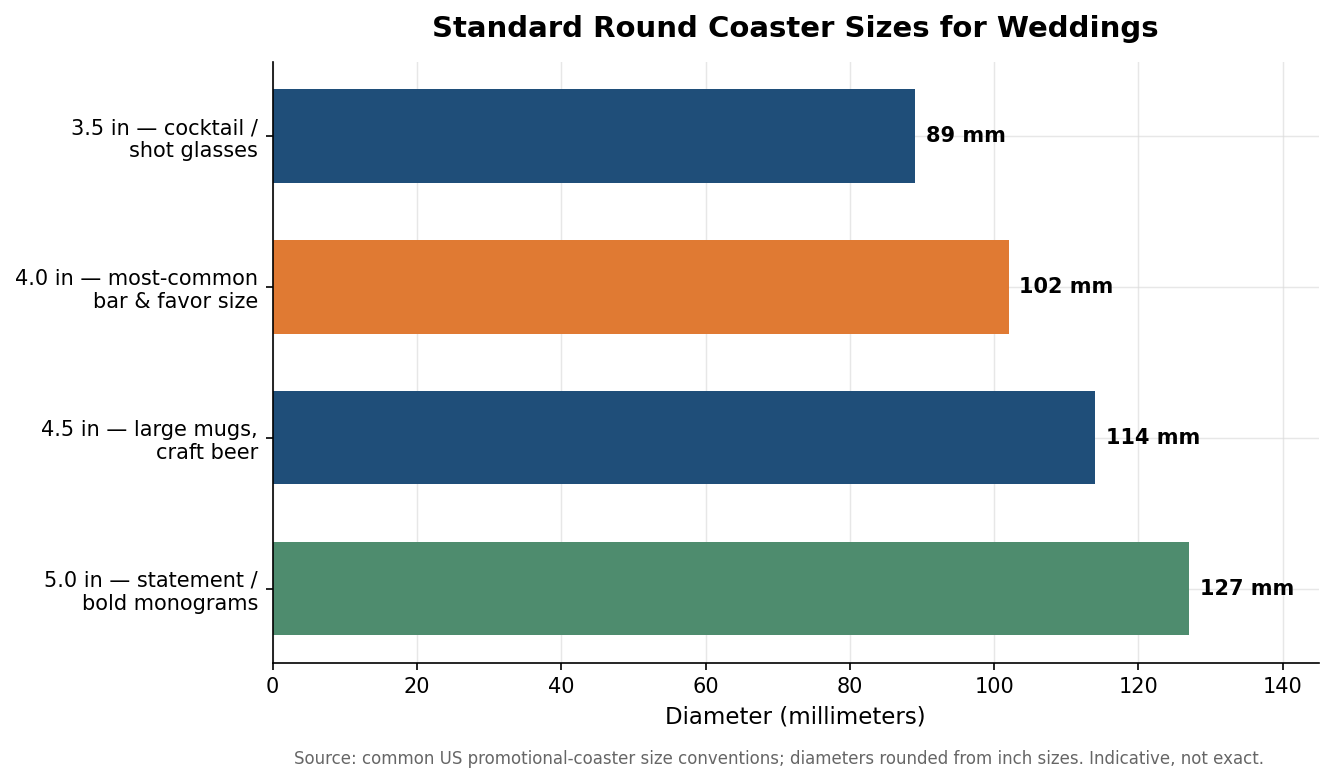
    The single most common promotional coaster in the United States is the 4-inch round (about 102 mm), and it is the safe default for a wedding. It sits comfortably under a wine glass, a rocks glass, a beer, or a water goblet without disappearing beneath the base or crowding a place setting. Drop to a 3.5-inch round (about 89 mm) only if your bar is serving mostly cocktails, coupes, and shot-style pours, where the smaller footprint looks intentional rather than skimpy. Sizes above 4.5 inches (114 mm) read as statement pieces — useful if you want a large monogram or a full illustration to carry the table, less useful if the coaster has to share space with chargers, flatware, and menu cards.

    Shape is mostly an aesthetic call, but it interacts with your artwork. A 4-by-4-inch square gives you flat edges that suit a modern monogram or a horizon-line date treatment, while a round coaster flatters a circular monogram, a wreath, or a seal. Square coasters also tile more neatly if you plan to stack them in a display. The chart below shows the common round sizes and where each one fits.

    Horizontal bar chart of standard round wedding coaster sizes from 3.5 to 5 inches in millimeters
    The 4-inch round is the workhorse size for most wedding bars and place-setting favors.

    How many to order

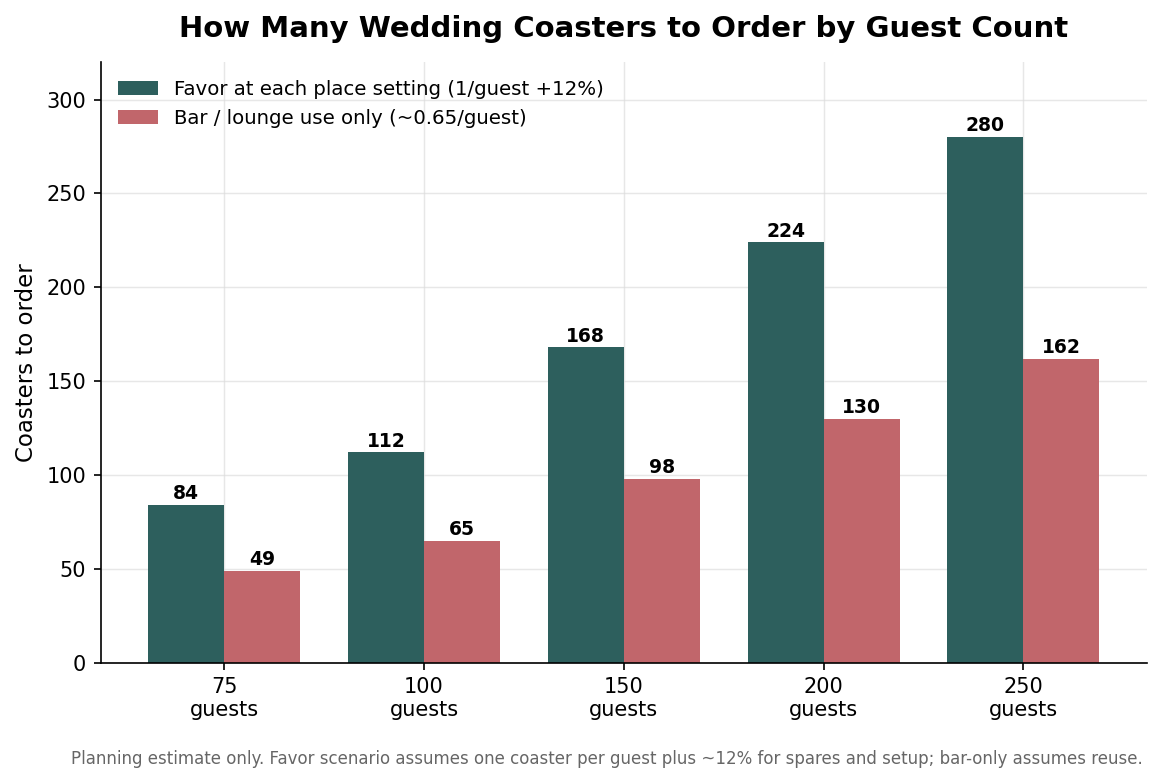
    Coaster quantity is where couples most often over- or under-buy, because the right number depends entirely on how you are using them. If the coaster is a favor set at every place setting, plan on one per guest plus roughly 10 to 15 percent for setup spares, damaged pieces, and the guests who take a second. If the coasters live only at the bar and cocktail-lounge areas, they get reused all night and you need far fewer — a working estimate is around 0.6 to 0.7 per guest, since a single coaster serves several drinks over the evening. Party-supply ordering guidance for receptions makes the same distinction in the opposite direction: it recommends ordering coasters below guest count precisely because, unlike cocktail napkins (typically 2 to 3 per person per hour), coasters are not consumed and discarded.

    The practical move is to decide the role first. For a 150-guest wedding, a place-setting favor works out to roughly 170 coasters, while bar-only use lands closer to 100. Printing in small batches is disproportionately expensive per piece, so if you are on the fence between two counts, rounding up to the next standard quantity usually costs little and spares you a reorder. The chart below plots both scenarios across common guest counts.

    Grouped bar chart comparing coaster order quantities for favor use versus bar-only use across guest counts
    Quantity depends on role: a per-guest favor needs far more coasters than reusable bar-area service.

    Choose the material for how it will be used

    Material decides both how the coaster performs on the night and how it survives as a keepsake. Printed pulpboard is the classic bar coaster: absorbent, inexpensive at volume, and available in weights that are usually quoted in points — roughly 40 pt at about 1 mm, 60 pt at about 1.5 mm, and 80 pt at about 2 mm. Thicker stock absorbs more condensation and feels more substantial, which matters when the coaster doubles as a favor. The trade-off is that pulpboard is single-use in spirit; it will soften if it sits in a puddle all night, and it is not something most guests keep for years.

    Cork (commonly 3 to 6 mm thick) reads more as a durable memento and resists moisture rings better over repeated use, which suits couples who want guests to actually take the coaster home and use it. Rubber or neoprene coasters, with a fabric-topped printable surface, are the most durable of the three and photograph vividly, but they cost more per unit and can feel more corporate than romantic depending on your design. If the coaster is primarily a bar workhorse, pulpboard is the value choice; if it is primarily a favor, cork or neoprene justify their premium.

    Design so the artwork survives the edges

    Personalization is the whole point — names, a monogram, the wedding date, sometimes a venue illustration or a short line like a hashtag. The technical rule that saves the most reprints is to keep essential text and logos away from the trim edge. Ask your printer for the required bleed and safe-area measurements before you design; a common setup is a small amount of image bleed past the cut line with critical elements pulled in an eighth of an inch or so, because die-cutting drifts slightly from piece to piece. Round coasters are less forgiving of text placed near the rim than squares, so center-weighted layouts hold up better. Decide early whether you want printing on one side or both: double-sided lets you split a monogram on the front from a thank-you or date on the back, at a modest added cost.

    High-contrast art reproduces best on absorbent pulpboard, which does not hold fine gradients as crisply as a coated card would. If your design leans on subtle tonal shifts, a cork or neoprene surface will render it more faithfully. Send print-ready vector art where you can, so the monogram stays sharp at the coaster’s small size.

    Give yourself a realistic timeline

    Custom coaster production commonly runs on the order of two to three weeks for the print run itself, before shipping, though this varies widely by printer, decoration method, and season — treat it as indicative and confirm the exact lead time when you order. Because weddings cluster in late spring through fall, queues lengthen in peak months, so building in a buffer matters more than usual. A safe habit is to finalize artwork and place the order six to eight weeks before the date, which leaves room for a digital proof, one round of edits, and a shipping cushion.

    Minimum order quantities also shape the decision. Digitally printed runs often start in the low hundreds — roughly 100 to 250 pieces is typical — while traditional offset printing can carry minimums in the thousands, sometimes 5,000 or more, in exchange for a much lower per-piece cost at scale. These figures are indicative industry ranges rather than fixed rules; the crossover point where offset becomes cheaper than digital depends on the specific printer. For most weddings under a few hundred guests, a short-run digital order is the practical match.

    Put together, the decision is straightforward once you sequence it: pick 4-inch round as your default size unless your bar skews cocktail, decide whether the coaster is a favor or a bar piece and let that set your quantity, choose pulpboard for value or cork and neoprene for keepsake durability, keep your artwork clear of the edges, and order six to eight weeks out. Get those four calls right and the coaster does its quiet job all night — and then goes home in someone’s pocket.

  • How to Set Up Custom Coaster Artwork: Sizes, Bleed, and Print-Ready Files

    How to Set Up Custom Coaster Artwork: Sizes, Bleed, and Print-Ready Files

    A coaster is a small canvas with unforgiving rules. It is round or square, usually no wider than four inches, and it gets die-cut, so anything important that drifts too close to the edge gets sliced off. Most reprints and disappointing proofs trace back not to the design itself but to a file that was built without the print process in mind: art at screen resolution, colors in the wrong mode, no bleed, a logo crowding the cut line. Getting those mechanics right the first time is what separates a clean, on-brand coaster from a muddy one with a shaved-off tagline. This walkthrough covers the specs that matter, in the order you actually make the decisions.

    Start with size and shape

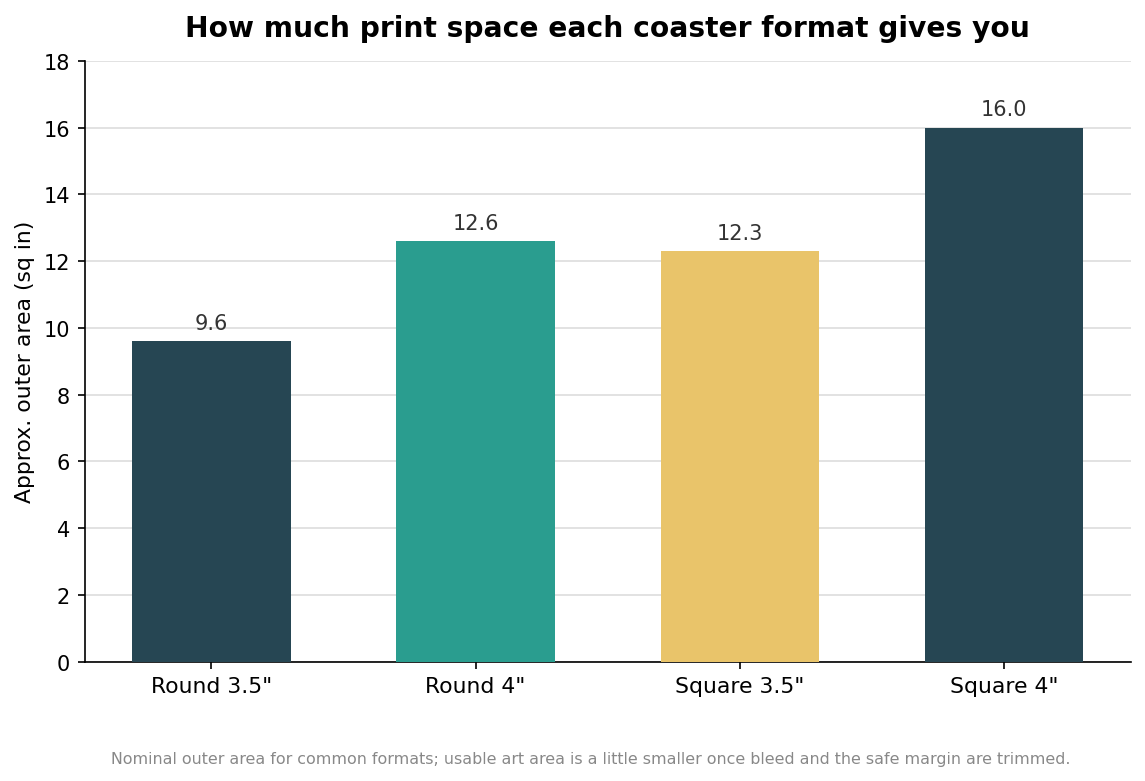
    The two most common coaster footprints are 3.5 inches and 4 inches, offered in both round and square. Round 3.5-inch (roughly 90 mm) is the classic bar coaster; the 4-inch square gives you the most surface to work with, which matters if your design has a lot to say. Shape is not just cosmetic. A square puts usable area in the corners that a round simply does not have, so the same logo effectively prints larger on a square of the same nominal size. Custom die-cut shapes, cut to the silhouette of a bottle or a badge, are available from most printers but add a cutting die and cost, and they shrink your safe printing area further because the cut path is more complex. Decide size and shape before you draw anything, because every later spec, bleed included, is measured from that edge.

    Bar chart of approximate outer print area in square inches for round and square coasters at 3.5 and 4 inches
    A square 4-inch coaster offers the most surface; usable art area is a little smaller after trim.

    Thickness is a spec, not a guess

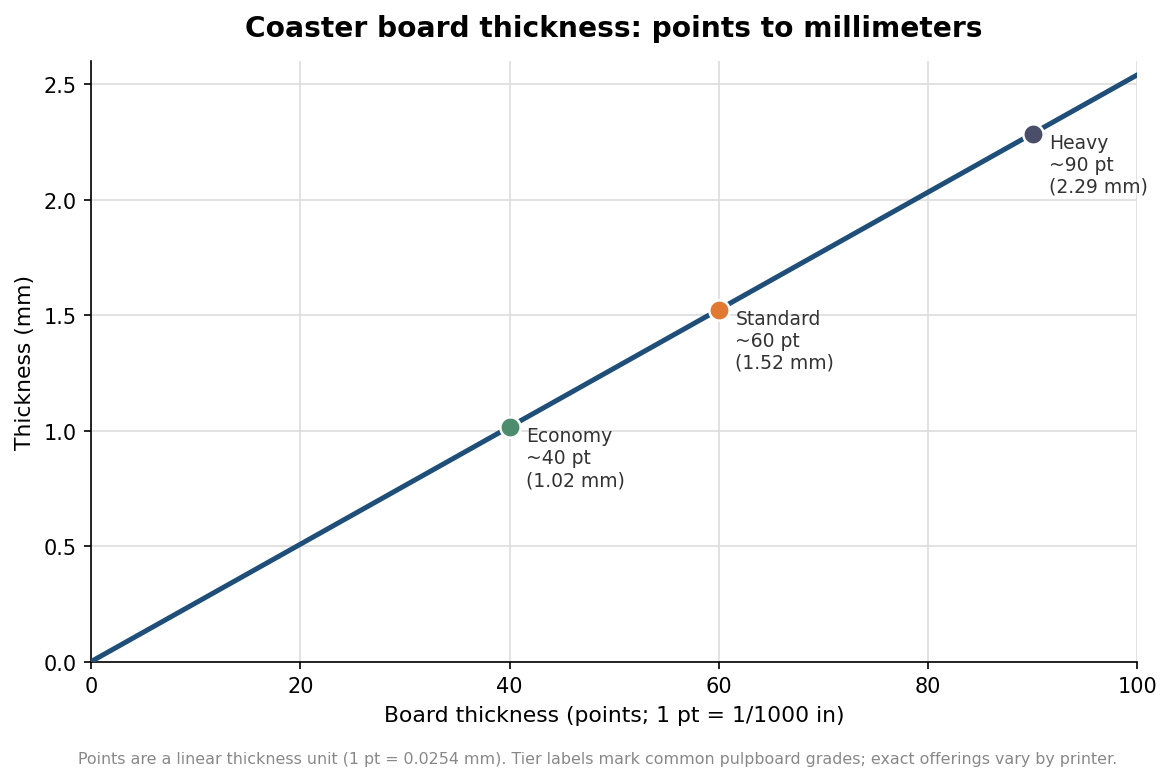
    Coaster board is measured in points, where one point equals one thousandth of an inch, so a 60-point coaster is 0.06 inches, or about 1.5 mm, thick. Economy pulpboard tends to land around 35 to 40 points, standard bar coasters commonly run about 60 points, and heavy premium stock climbs toward 90 points and beyond. Thickness does two things at once. It signals quality in the hand, a flimsy coaster reads as cheap, and on absorbent pulpboard it correlates loosely with how much condensation the coaster can soak up before it saturates. If your coaster’s job is to protect a bar top through a full pint’s worth of sweat, heavier absorbent board earns its slightly higher price. If it is a one-night promotional handout, lighter stock is a reasonable economy. State the point weight on your order rather than leaving it to assumption, because “standard” means different things at different printers.

    Line chart converting coaster board thickness from points to millimeters with economy, standard, and heavy tiers marked
    Board thickness in points converts linearly to millimeters; 60-point stock is about 1.5 mm.

    Build a print-ready file

    Four file rules cover most of what goes wrong. Work in CMYK, not RGB, because presses print in cyan, magenta, yellow, and black, and a vivid RGB blue or green that looks great on screen can shift noticeably once it is converted for print. Set raster art to 300 dpi at final size; a logo pulled from a website is usually 72 dpi and will look soft when it is blown up to coaster scale. Add bleed, meaning you extend any background color or image past the trim edge so that a slight shift during cutting never leaves a white sliver. A common requirement is a quarter inch of bleed past the edge, though some printers ask for an eighth inch, so confirm the number with yours. Keep text and logos inside a safe margin, often around three-sixteenths of an inch inside the cut line, so nothing critical rides the edge. Beyond those four, supply vector files where possible, with EPS or print-ready PDF the preferred formats, convert fonts to outlines or include the font files, and embed any placed images so nothing goes missing when the printer opens the file.

    The choices that change your quote

    A few remaining decisions move the price and the timeline more than buyers expect. The biggest is one side versus two: printing the back of a coaster is effectively a second print job and is priced that way, so if the back only needs a small handle or hashtag, decide whether the extra cost is worth it. Surface treatment matters too. Traditional pulpboard is uncoated so it stays absorbent, which is the point for a drink coaster; a coated or laminated finish looks glossier and resists staining but reduces absorbency, a genuine trade-off rather than a strict upgrade. Ink coverage plays in as well, since a full-bleed dark background uses more ink and can show flooding on absorbent stock, where a design with more open board prints cleaner. Finally, quantity drives the unit price hard: coasters are cheapest by the thousand, and most printers set a minimum order, so it is worth pricing a couple of quantity tiers before you commit.

    A quick pre-send checklist

    Before you hand off artwork, run a short mental pass. Confirm the document is built at the exact coaster size with bleed added and the safe margin respected, that the color mode is CMYK, and that raster elements sit at 300 dpi. Check that fonts are outlined or supplied and that images are embedded. Note the point weight, the shape, whether it is one or two sides, and the coating on the order itself rather than in a separate email that can get lost. Ask for a proof and read it against these specs, not just for typos, since the proof is the last cheap moment to catch a problem. Coasters are inexpensive per piece, which is exactly why a mistake stings, a small error multiplies across a large run. Spend the extra ten minutes on the file, and the print takes care of itself.

  • Coaster Materials Compared: Pulpboard, Cork, and Neoprene for Bars and Brands

    Coaster Materials Compared: Pulpboard, Cork, and Neoprene for Bars and Brands

    Choosing a custom coaster material is really three decisions in one. Does the coaster get tossed with the empties or live on a desk for years? How much condensation does it need to soak up? And how does your artwork get onto it — full-color print, engraving, or dye sublimation? Answer those and the material almost picks itself. Three options — pulpboard, cork, and neoprene — cover the large majority of custom coaster orders, and each is built for a different job. Getting the fit right up front saves you from a reorder when the first batch turns out too flimsy, too plain, or too expensive for what it needs to do.

    Pulpboard: the disposable workhorse for bars and breweries

    Pulpboard is the classic beer mat: absorbent recycled paperboard, printed in full color by offset, and priced to be handed out by the thousand. It soaks up condensation and drips better than any reusable surface, which is exactly why breweries and busy bars use it — the coaster does its job for a night and leaves with the crowd. Artwork prints in sharp CMYK on one or both sides, so a photographic logo, a full-bleed design, or a promotion on the back reproduces cleanly. The stock is commonly 100 percent recycled paper, which also makes it the easy answer when sustainability matters and reuse does not.

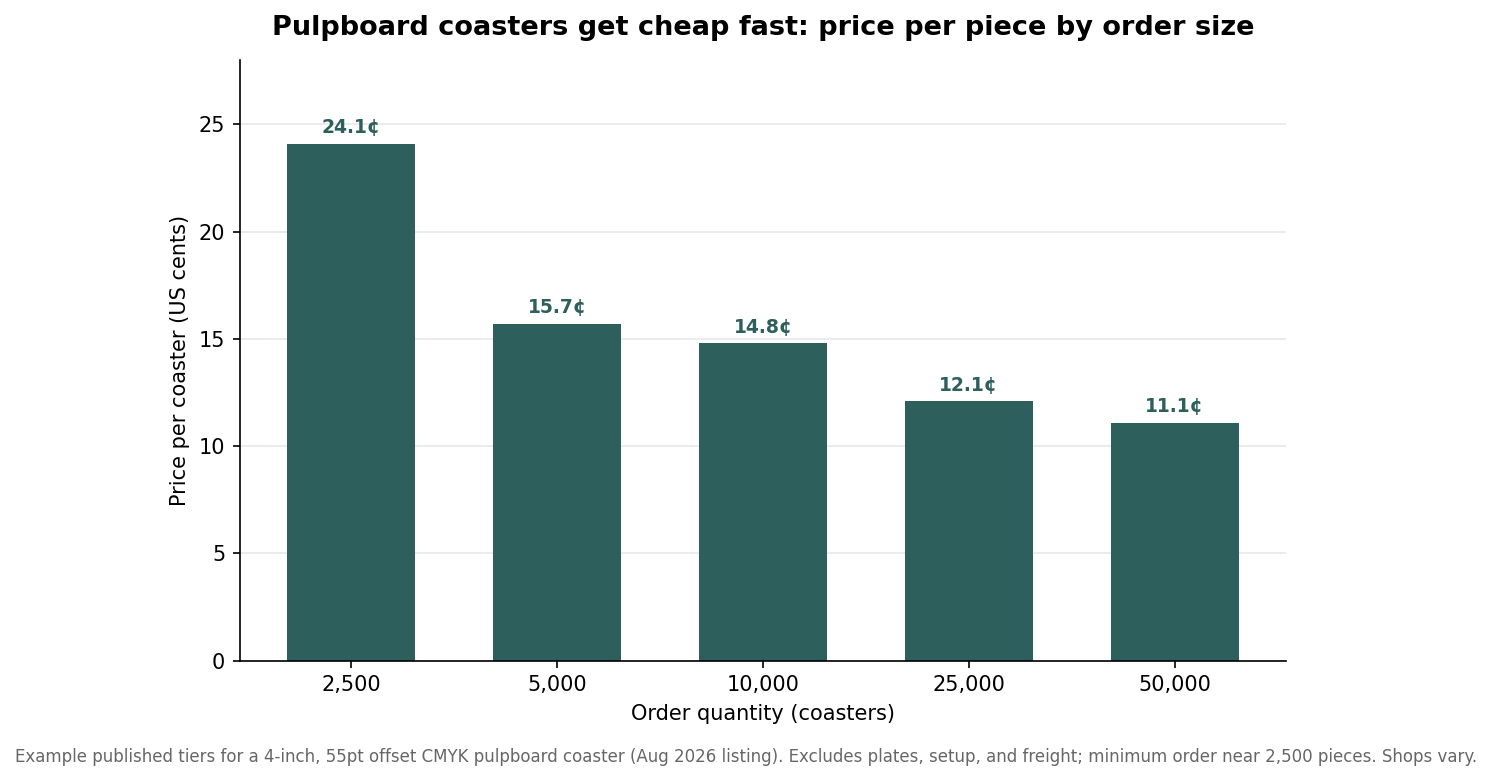
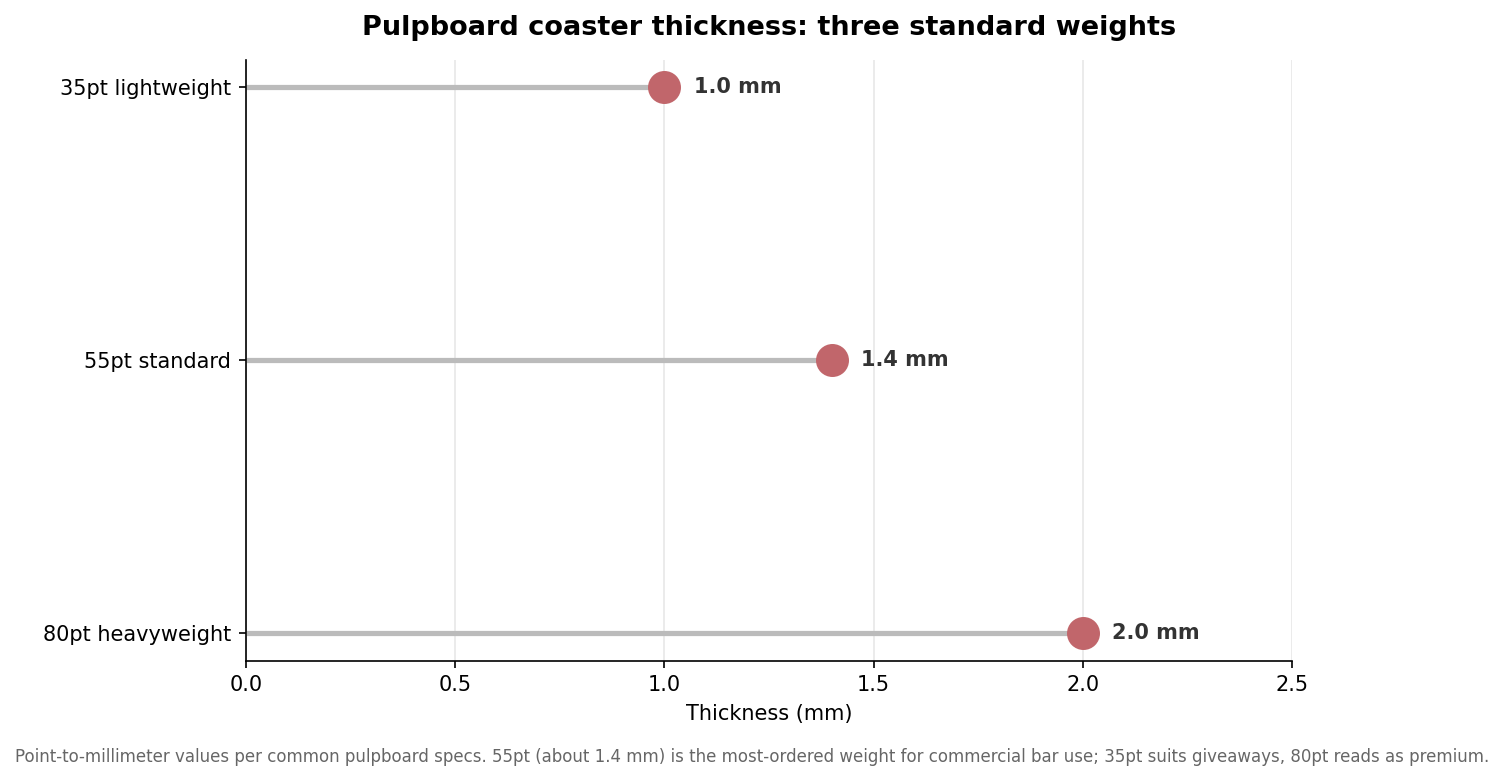
    The trade-off is that offset printing wants volume. Minimum orders commonly start around 2,500 pieces per design, because the economics come from the press run rather than the piece, and plates have to be made before anything prints. That same volume is what makes pulpboard the cheapest option per coaster by a wide margin — pennies each at scale. Standard commercial stock is 55 to 60 point, about 1.4 millimeters; a 35-point lightweight (roughly 1 millimeter) trims cost for giveaways, while an 80-point heavyweight (about 2 millimeters) adds a premium heft. Common sizes are 3.5 and 4 inches, round or square, and lead times generally run a couple of weeks after you approve the proof.

    Bar chart of pulpboard coaster price per piece falling from about 24 cents at 2,500 units to about 11 cents at 50,000 units
    Offset pulpboard rewards volume: per-piece price falls sharply as the order size grows.

    Cork: the reusable, eco-friendly pick

    Cork moves the coaster from disposable to reusable. It absorbs moisture naturally, resists water rings, and holds up to repeated use, which suits cafes, wineries, boutique hotels, and brands that want a sustainable, tactile product a customer keeps. Most cork coasters run a few millimeters thick, sometimes with a printed paper top layer or a bonded backing for stability, and they carry a natural, slightly rustic look straight out of the box.

    The catch is decoration. Cork takes laser engraving and simple, bold graphics well, but it is not the surface for a full-color photographic logo — the grain and the burn tone limit you to clean line work and solid shapes. If your brand mark is a tidy one- or two-color design or a wordmark, cork looks premium and natural; if it depends on gradients or photography, cork will fight you. Cork coasters cost more per piece than pulpboard, but minimum orders are typically far lower than an offset pulpboard run — often in the low hundreds — which makes them practical for smaller batches, retail shelves, and gift sets.

    Neoprene: washable, full-color, and built to last

    Neoprene — the same rubber-backed material as a laptop sleeve — is the durable, reusable option that still takes a full-color image. It prints by dye sublimation, so photographic artwork and gradients reproduce vividly across the whole face, and the finished coaster is washable and holds its look for years. A typical neoprene coaster is around 3 millimeters thick with a stitched or heat-sealed edge and a slightly cushioned feel. The base is non-absorbent, so it relies on that textured, cushioned surface rather than soaking moisture in; a cloth-top neoprene coaster wipes clean instead of wicking. That makes it the pick for hotels, outdoor venues, high-traffic bars, and branded merchandise a customer takes home and keeps. Expect a higher unit price than pulpboard and cork, offset by a much longer life and lower minimums than an offset run.

    Lollipop chart showing pulpboard coaster thickness grades: 35pt at 1.0mm, 55pt at 1.4mm, 80pt at 2.0mm
    The three standard pulpboard weights, with 55pt the usual commercial choice.

    Matching the material to the job

    Start from how the coaster is used. High-volume, single-night service where drips and condensation are the enemy points straight to pulpboard, and the volume you need makes its per-piece price the lowest of the three. A reusable, eco-forward product with a simple mark — a winery, a cafe, a design-led brand — points to cork. A washable, full-color coaster meant to survive years of use, or to be sold and taken home, points to neoprene. If the goal is a luxury, permanent piece, ceramic or stone coasters sit above all three on both price and weight, printed by sublimation or decal, but they are a different category aimed at gift and premium retail rather than everyday service. Order quantity often settles the question on its own: if you need thousands and want them cheap, pulpboard is the only one that gets there; if you need a few hundred keepsakes, cork or neoprene fit the run size far better.

    Thickness and size change the feel and the cost

    Within a material, thickness is the lever that shifts perceived quality and price. On pulpboard, 55-point stock (about 1.4 millimeters) is the most-ordered commercial weight because it feels substantial without wasting board; 35-point is the budget giveaway, and 80-point (about 2 millimeters) reads as premium in the hand. Size matters too. A 4-inch coaster gives a logo more room and protects a larger table footprint, while 3.5-inch is the compact standard; square shapes maximize the print area for a full-bleed design, round shapes read as classic bar. Decide material first, then set thickness and size to match the impression you want and the budget you have, and the proof will behave the way the finished coaster does on the table.