Choosing a custom coaster material is really three decisions in one. Does the coaster get tossed with the empties or live on a desk for years? How much condensation does it need to soak up? And how does your artwork get onto it — full-color print, engraving, or dye sublimation? Answer those and the material almost picks itself. Three options — pulpboard, cork, and neoprene — cover the large majority of custom coaster orders, and each is built for a different job. Getting the fit right up front saves you from a reorder when the first batch turns out too flimsy, too plain, or too expensive for what it needs to do.
Pulpboard: the disposable workhorse for bars and breweries
Pulpboard is the classic beer mat: absorbent recycled paperboard, printed in full color by offset, and priced to be handed out by the thousand. It soaks up condensation and drips better than any reusable surface, which is exactly why breweries and busy bars use it — the coaster does its job for a night and leaves with the crowd. Artwork prints in sharp CMYK on one or both sides, so a photographic logo, a full-bleed design, or a promotion on the back reproduces cleanly. The stock is commonly 100 percent recycled paper, which also makes it the easy answer when sustainability matters and reuse does not.
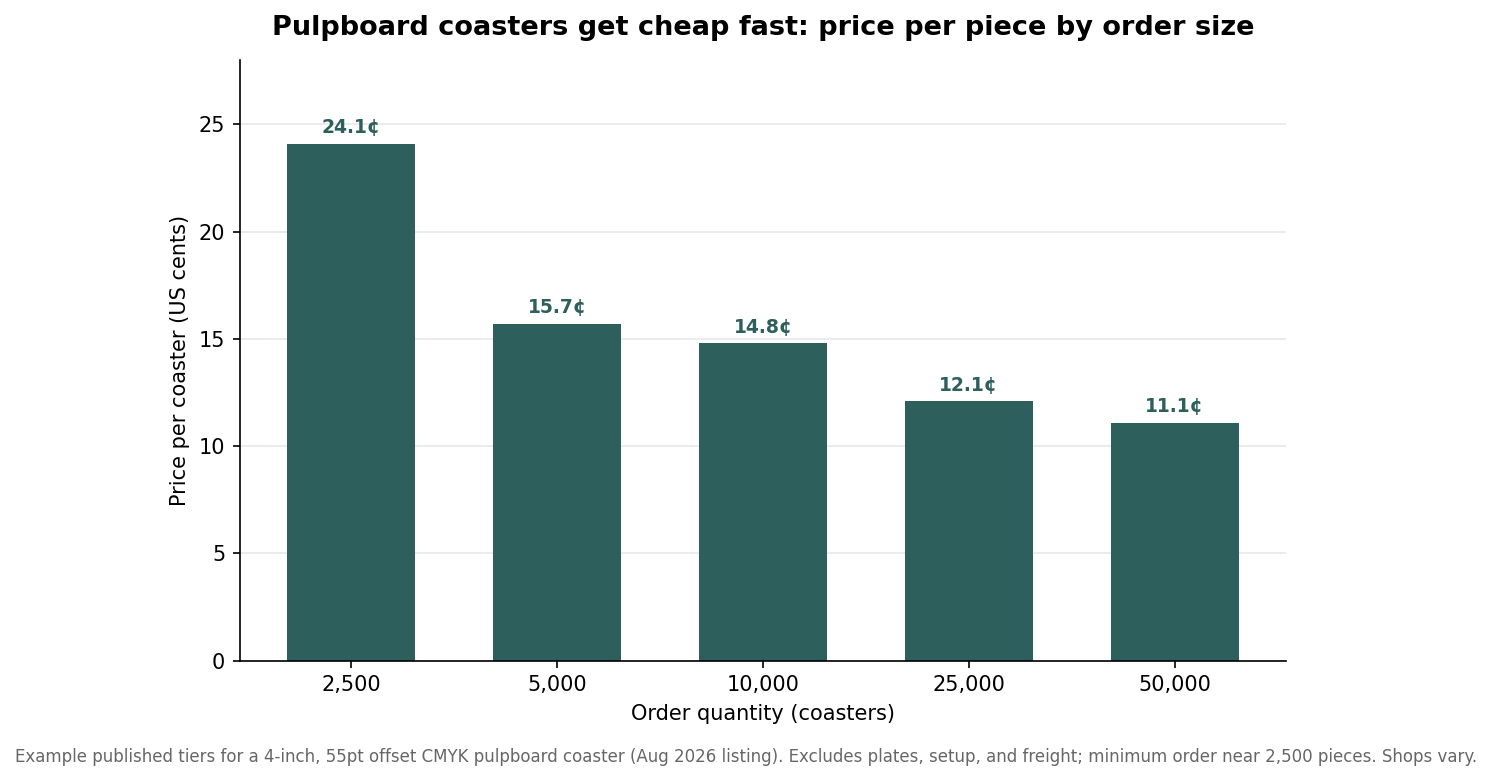
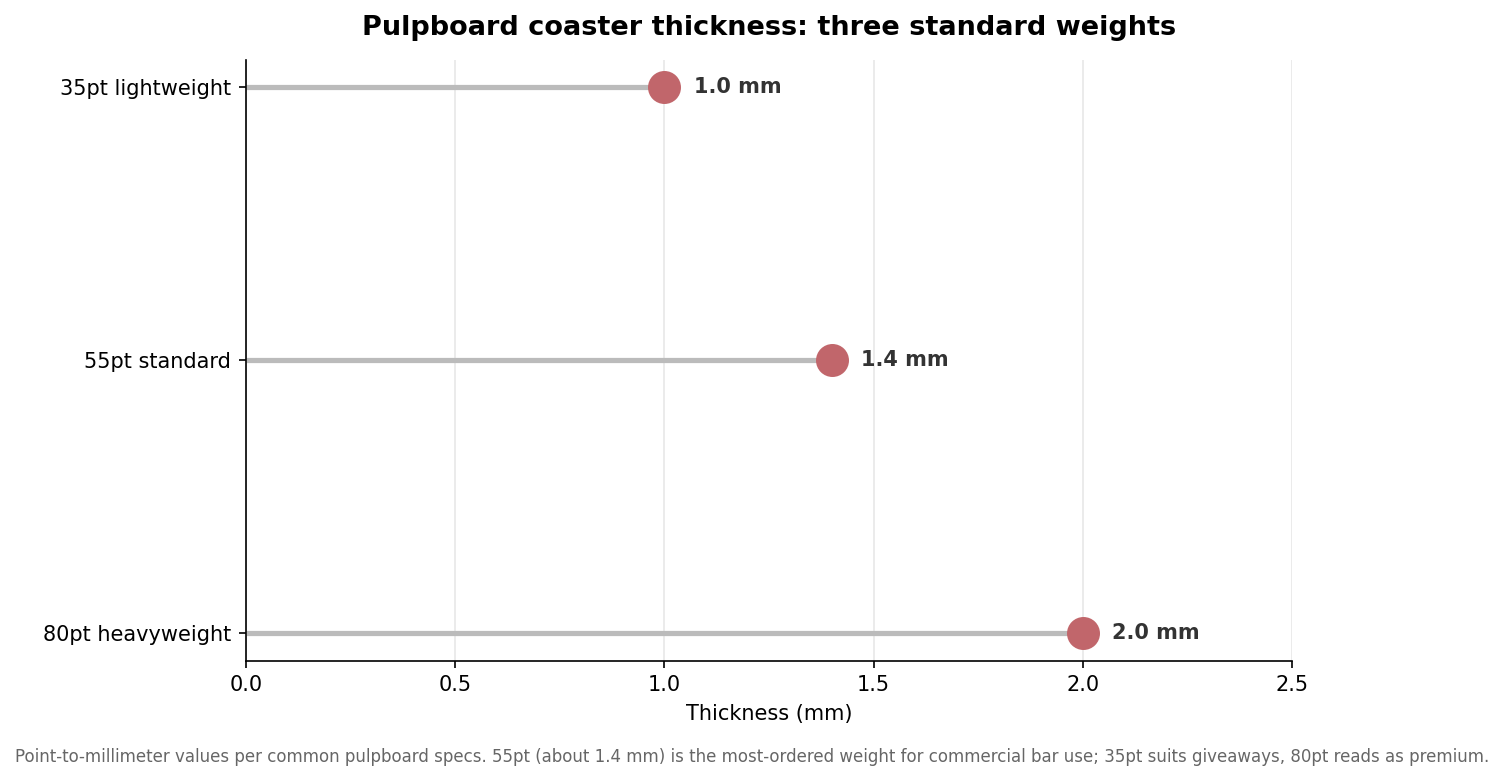
The trade-off is that offset printing wants volume. Minimum orders commonly start around 2,500 pieces per design, because the economics come from the press run rather than the piece, and plates have to be made before anything prints. That same volume is what makes pulpboard the cheapest option per coaster by a wide margin — pennies each at scale. Standard commercial stock is 55 to 60 point, about 1.4 millimeters; a 35-point lightweight (roughly 1 millimeter) trims cost for giveaways, while an 80-point heavyweight (about 2 millimeters) adds a premium heft. Common sizes are 3.5 and 4 inches, round or square, and lead times generally run a couple of weeks after you approve the proof.
Cork: the reusable, eco-friendly pick
Cork moves the coaster from disposable to reusable. It absorbs moisture naturally, resists water rings, and holds up to repeated use, which suits cafes, wineries, boutique hotels, and brands that want a sustainable, tactile product a customer keeps. Most cork coasters run a few millimeters thick, sometimes with a printed paper top layer or a bonded backing for stability, and they carry a natural, slightly rustic look straight out of the box.
The catch is decoration. Cork takes laser engraving and simple, bold graphics well, but it is not the surface for a full-color photographic logo — the grain and the burn tone limit you to clean line work and solid shapes. If your brand mark is a tidy one- or two-color design or a wordmark, cork looks premium and natural; if it depends on gradients or photography, cork will fight you. Cork coasters cost more per piece than pulpboard, but minimum orders are typically far lower than an offset pulpboard run — often in the low hundreds — which makes them practical for smaller batches, retail shelves, and gift sets.
Neoprene: washable, full-color, and built to last
Neoprene — the same rubber-backed material as a laptop sleeve — is the durable, reusable option that still takes a full-color image. It prints by dye sublimation, so photographic artwork and gradients reproduce vividly across the whole face, and the finished coaster is washable and holds its look for years. A typical neoprene coaster is around 3 millimeters thick with a stitched or heat-sealed edge and a slightly cushioned feel. The base is non-absorbent, so it relies on that textured, cushioned surface rather than soaking moisture in; a cloth-top neoprene coaster wipes clean instead of wicking. That makes it the pick for hotels, outdoor venues, high-traffic bars, and branded merchandise a customer takes home and keeps. Expect a higher unit price than pulpboard and cork, offset by a much longer life and lower minimums than an offset run.
Matching the material to the job
Start from how the coaster is used. High-volume, single-night service where drips and condensation are the enemy points straight to pulpboard, and the volume you need makes its per-piece price the lowest of the three. A reusable, eco-forward product with a simple mark — a winery, a cafe, a design-led brand — points to cork. A washable, full-color coaster meant to survive years of use, or to be sold and taken home, points to neoprene. If the goal is a luxury, permanent piece, ceramic or stone coasters sit above all three on both price and weight, printed by sublimation or decal, but they are a different category aimed at gift and premium retail rather than everyday service. Order quantity often settles the question on its own: if you need thousands and want them cheap, pulpboard is the only one that gets there; if you need a few hundred keepsakes, cork or neoprene fit the run size far better.
Thickness and size change the feel and the cost
Within a material, thickness is the lever that shifts perceived quality and price. On pulpboard, 55-point stock (about 1.4 millimeters) is the most-ordered commercial weight because it feels substantial without wasting board; 35-point is the budget giveaway, and 80-point (about 2 millimeters) reads as premium in the hand. Size matters too. A 4-inch coaster gives a logo more room and protects a larger table footprint, while 3.5-inch is the compact standard; square shapes maximize the print area for a full-bleed design, round shapes read as classic bar. Decide material first, then set thickness and size to match the impression you want and the budget you have, and the proof will behave the way the finished coaster does on the table.