Wedding coasters are one of the few reception details a guest can actually pick up, use all night, and slip into a pocket on the way out. That double life — working drink protector during the party, small keepsake afterward — is exactly what makes them easy to get wrong. Order the size meant for a bar rail and it swims under a water goblet; order a quantity based on guest count when you only need them at the bar and you finish with three unopened boxes. This walkthrough covers the four decisions that actually determine whether your coasters land right: size and shape, how many to order, material, and artwork, plus a realistic ordering timeline.
Start with size and shape
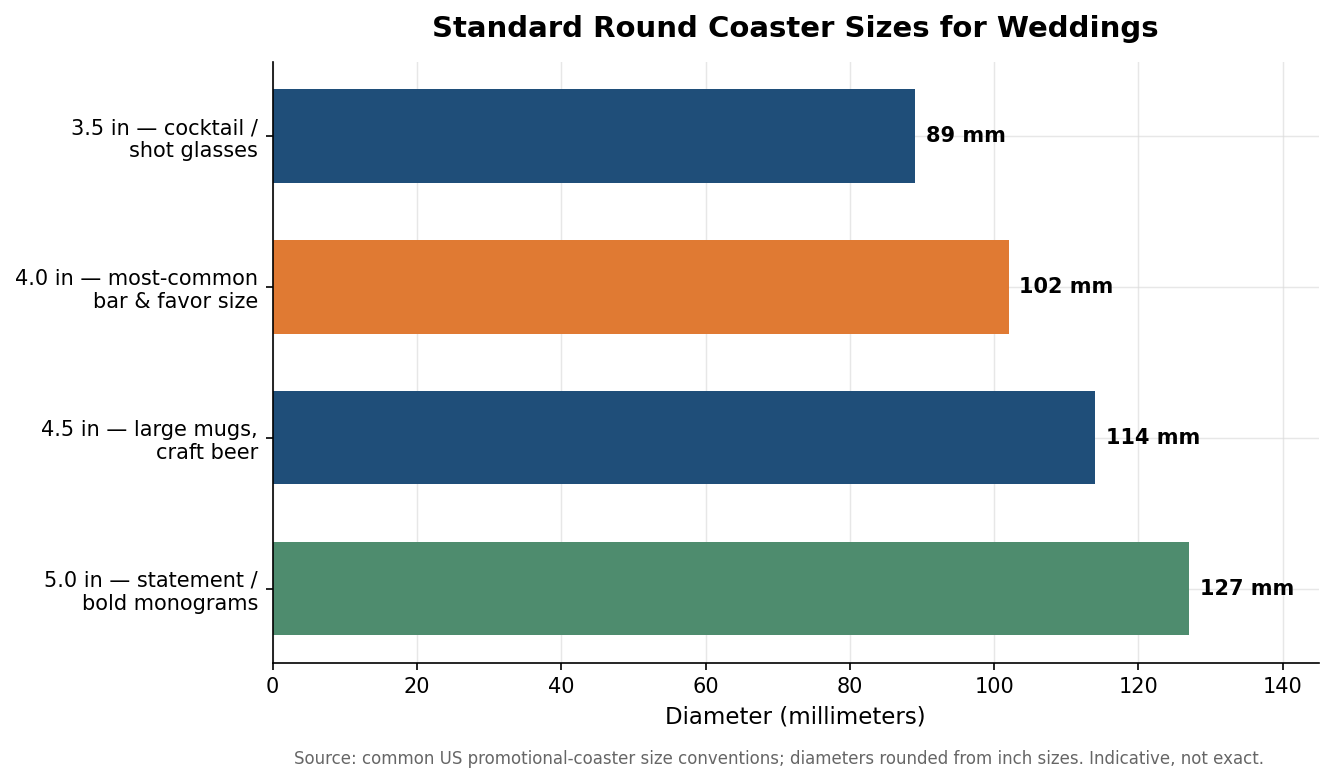
The single most common promotional coaster in the United States is the 4-inch round (about 102 mm), and it is the safe default for a wedding. It sits comfortably under a wine glass, a rocks glass, a beer, or a water goblet without disappearing beneath the base or crowding a place setting. Drop to a 3.5-inch round (about 89 mm) only if your bar is serving mostly cocktails, coupes, and shot-style pours, where the smaller footprint looks intentional rather than skimpy. Sizes above 4.5 inches (114 mm) read as statement pieces — useful if you want a large monogram or a full illustration to carry the table, less useful if the coaster has to share space with chargers, flatware, and menu cards.
Shape is mostly an aesthetic call, but it interacts with your artwork. A 4-by-4-inch square gives you flat edges that suit a modern monogram or a horizon-line date treatment, while a round coaster flatters a circular monogram, a wreath, or a seal. Square coasters also tile more neatly if you plan to stack them in a display. The chart below shows the common round sizes and where each one fits.
How many to order
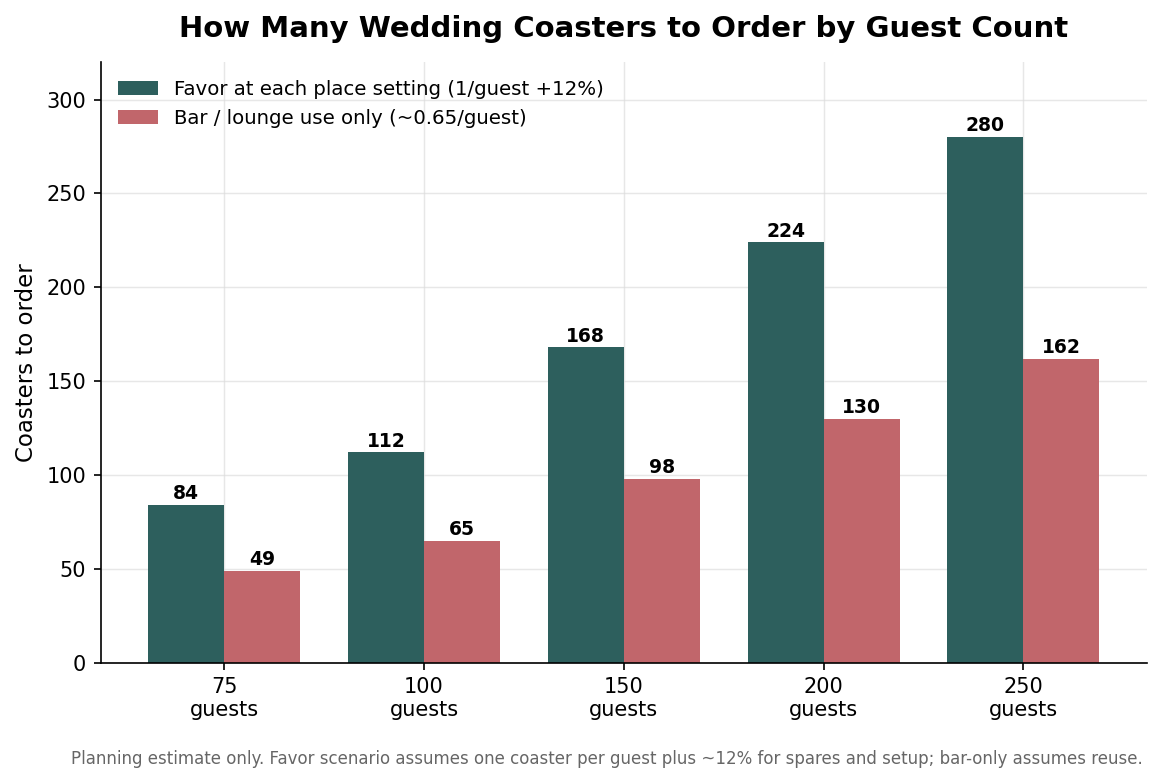
Coaster quantity is where couples most often over- or under-buy, because the right number depends entirely on how you are using them. If the coaster is a favor set at every place setting, plan on one per guest plus roughly 10 to 15 percent for setup spares, damaged pieces, and the guests who take a second. If the coasters live only at the bar and cocktail-lounge areas, they get reused all night and you need far fewer — a working estimate is around 0.6 to 0.7 per guest, since a single coaster serves several drinks over the evening. Party-supply ordering guidance for receptions makes the same distinction in the opposite direction: it recommends ordering coasters below guest count precisely because, unlike cocktail napkins (typically 2 to 3 per person per hour), coasters are not consumed and discarded.
The practical move is to decide the role first. For a 150-guest wedding, a place-setting favor works out to roughly 170 coasters, while bar-only use lands closer to 100. Printing in small batches is disproportionately expensive per piece, so if you are on the fence between two counts, rounding up to the next standard quantity usually costs little and spares you a reorder. The chart below plots both scenarios across common guest counts.
Choose the material for how it will be used
Material decides both how the coaster performs on the night and how it survives as a keepsake. Printed pulpboard is the classic bar coaster: absorbent, inexpensive at volume, and available in weights that are usually quoted in points — roughly 40 pt at about 1 mm, 60 pt at about 1.5 mm, and 80 pt at about 2 mm. Thicker stock absorbs more condensation and feels more substantial, which matters when the coaster doubles as a favor. The trade-off is that pulpboard is single-use in spirit; it will soften if it sits in a puddle all night, and it is not something most guests keep for years.
Cork (commonly 3 to 6 mm thick) reads more as a durable memento and resists moisture rings better over repeated use, which suits couples who want guests to actually take the coaster home and use it. Rubber or neoprene coasters, with a fabric-topped printable surface, are the most durable of the three and photograph vividly, but they cost more per unit and can feel more corporate than romantic depending on your design. If the coaster is primarily a bar workhorse, pulpboard is the value choice; if it is primarily a favor, cork or neoprene justify their premium.
Design so the artwork survives the edges
Personalization is the whole point — names, a monogram, the wedding date, sometimes a venue illustration or a short line like a hashtag. The technical rule that saves the most reprints is to keep essential text and logos away from the trim edge. Ask your printer for the required bleed and safe-area measurements before you design; a common setup is a small amount of image bleed past the cut line with critical elements pulled in an eighth of an inch or so, because die-cutting drifts slightly from piece to piece. Round coasters are less forgiving of text placed near the rim than squares, so center-weighted layouts hold up better. Decide early whether you want printing on one side or both: double-sided lets you split a monogram on the front from a thank-you or date on the back, at a modest added cost.
High-contrast art reproduces best on absorbent pulpboard, which does not hold fine gradients as crisply as a coated card would. If your design leans on subtle tonal shifts, a cork or neoprene surface will render it more faithfully. Send print-ready vector art where you can, so the monogram stays sharp at the coaster’s small size.
Give yourself a realistic timeline
Custom coaster production commonly runs on the order of two to three weeks for the print run itself, before shipping, though this varies widely by printer, decoration method, and season — treat it as indicative and confirm the exact lead time when you order. Because weddings cluster in late spring through fall, queues lengthen in peak months, so building in a buffer matters more than usual. A safe habit is to finalize artwork and place the order six to eight weeks before the date, which leaves room for a digital proof, one round of edits, and a shipping cushion.
Minimum order quantities also shape the decision. Digitally printed runs often start in the low hundreds — roughly 100 to 250 pieces is typical — while traditional offset printing can carry minimums in the thousands, sometimes 5,000 or more, in exchange for a much lower per-piece cost at scale. These figures are indicative industry ranges rather than fixed rules; the crossover point where offset becomes cheaper than digital depends on the specific printer. For most weddings under a few hundred guests, a short-run digital order is the practical match.
Put together, the decision is straightforward once you sequence it: pick 4-inch round as your default size unless your bar skews cocktail, decide whether the coaster is a favor or a bar piece and let that set your quantity, choose pulpboard for value or cork and neoprene for keepsake durability, keep your artwork clear of the edges, and order six to eight weeks out. Get those four calls right and the coaster does its quiet job all night — and then goes home in someone’s pocket.